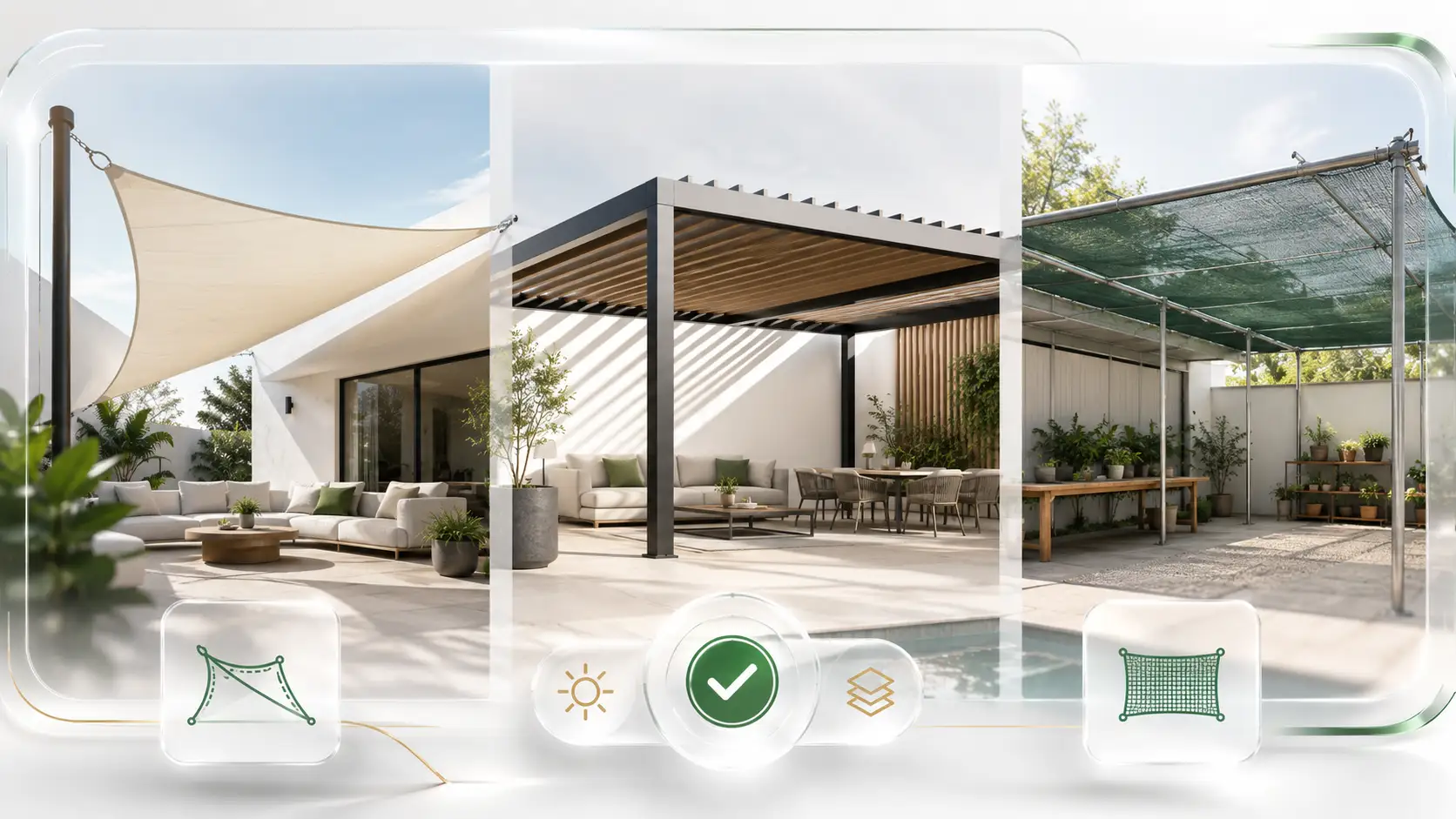
Most people choose an outdoor cover on appearance alone, and then July arrives. The area sits in shade, yet it still feels like an oven. That is not bad luck, it is simply the wrong structure for this climate.
In the shade sail vs pergola decision, with the shade net alongside them, each option wins a different job. A shade sail suits courtyards and irregular shapes where appearance matters most. A pergola suits a permanent outdoor room with real rain cover. A shade net delivers the best airflow and the lowest cost per covered metre.
This guide compares all three for UAE properties. It covers the same ground as most villa and garden shade projects here: lawns, patios, terraces and pool areas. Parking is a separate job with different rules, so it sits outside this guide.
Key Takeaways
- Heat is the first filter, because trapped air has to escape or shade alone will never cool the area.
- Wind is the second filter. Shamal season decides which structures hold and which ones fail.
- How often you actually use the space is the third filter, and it determines how much to invest.
- The three options are not rivals, and many properties end up combining two of them.
Shade Sail vs Pergola vs Shade Net at a Glance
A shade sail is fabric tensioned between fixed anchor points. A pergola is a built frame carrying beams or louvres. A shade net is knitted mesh stretched over a simple structure. All three block sunlight, but they separate on airflow, wind performance, rain cover and price.
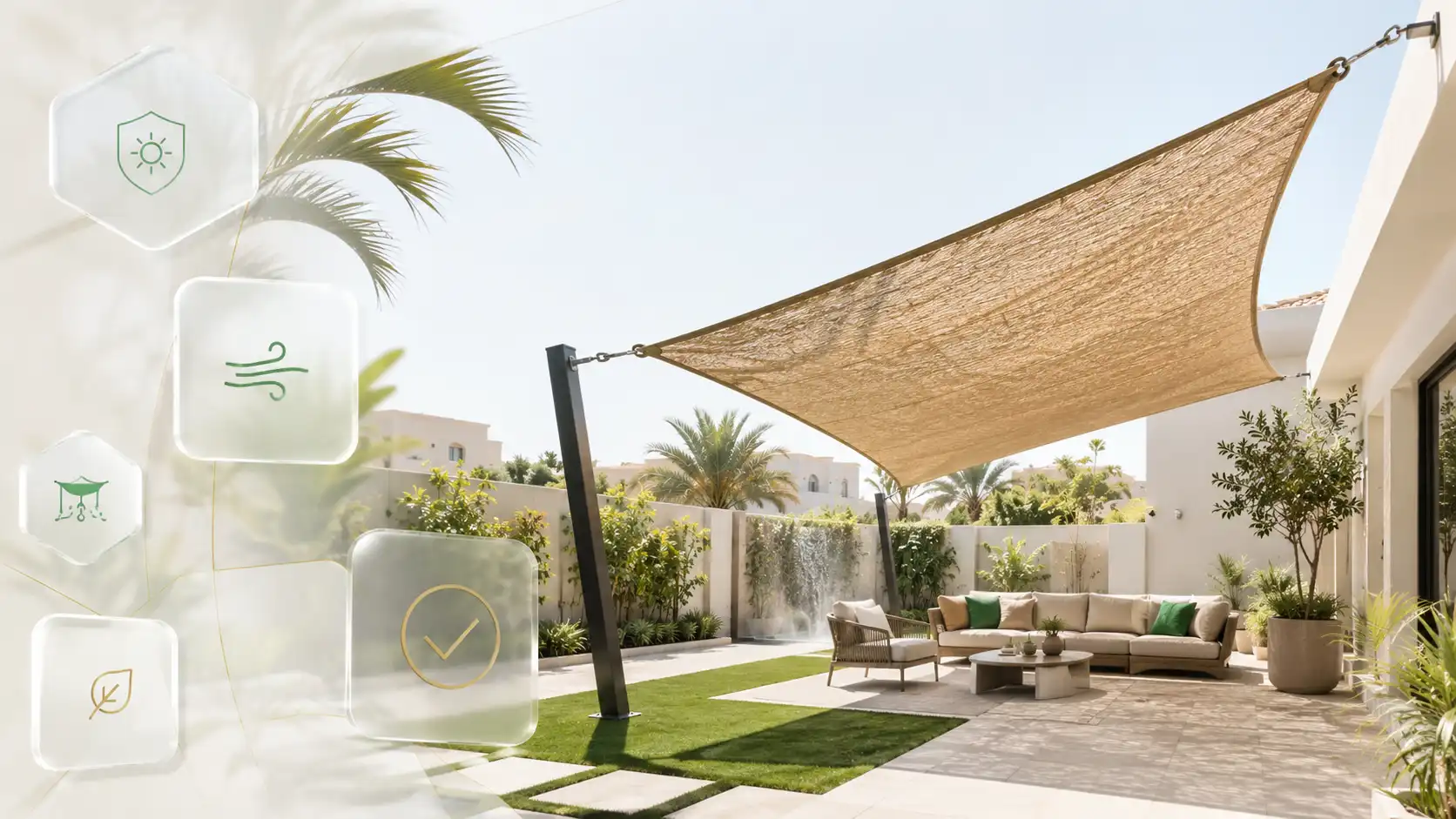
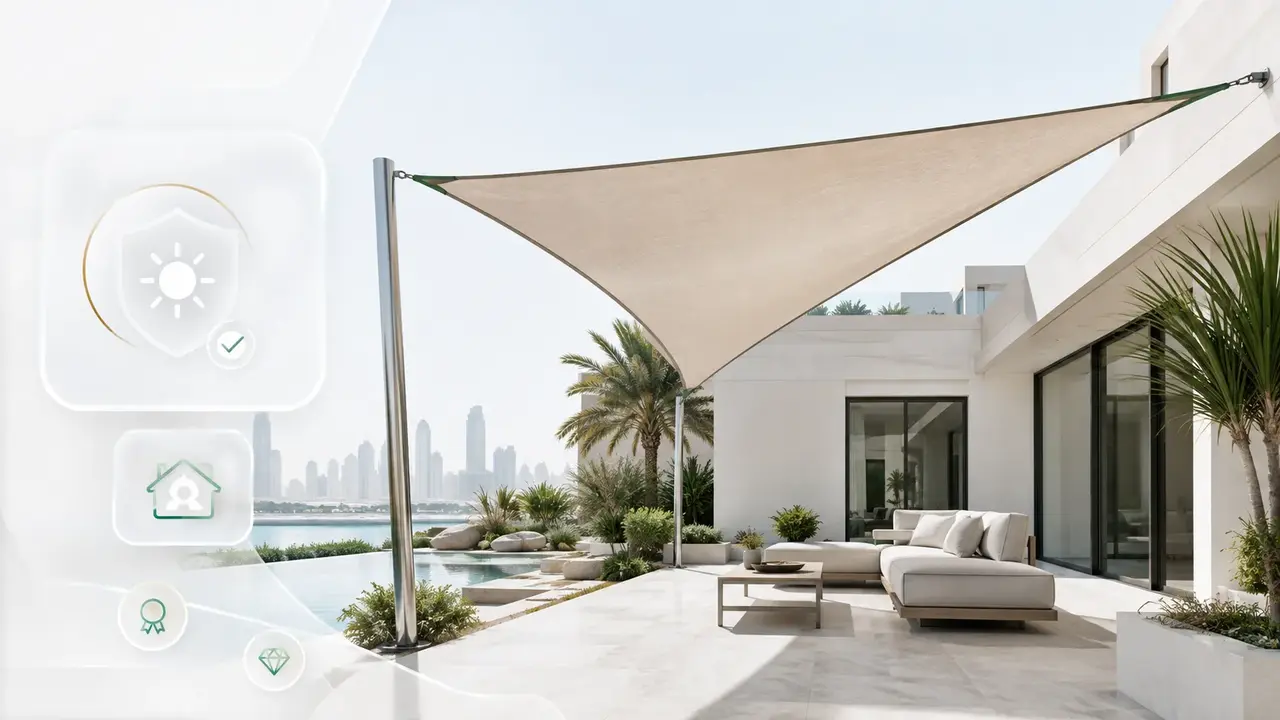
A shade sail is shaped fabric held under tension, fixed to three or four points such as a wall, a post or a beam. Overlapping sails cover irregular areas that a rectangular frame cannot handle. For a smaller courtyard, a ready made panel such as a beige sail shade net covers the span without the expense of fabricating a frame around it.
A pergola is a permanent frame where posts carry beams. The roof can be open slats, adjustable louvres or a solid panel. It reads as part of the architecture rather than an addition, so you can hang lighting from it and leave furniture underneath all year.
A shade net is a knitted mesh, usually HDPE, stretched over posts or tensioned wires. It is the plainest of the three and the cheapest per square metre. It also breathes better than anything else here.
| Shade sail | Pergola | Shade net | |
| What it is | Fabric tensioned between anchors | Frame carrying beams or louvres | Knitted mesh over a structure |
| Airflow underneath | High | Low to moderate | Highest |
| UV control | High | Depends on slat spacing | High |
| Wind performance | Lowest, load concentrates | Strongest | Good, wind passes through |
| Dust and cleaning | Accumulates if pitched flat | Collects along beams | Passes through the weave |
| Rain cover | Minimal unless coated | Good with a solid roof | None |
| Fabric replaced separately | Yes | Roof only | Yes |
| Relative cost | Low to mid | Highest | Lowest |
| Best suited to | Courtyards and irregular plots | Permanent outdoor rooms | Gardens and larger areas |
Which Option Handles Dubai Heat Best?
A shade net handles UAE heat best, with a shade sail close behind. Both use a knitted weave that allows hot air to rise and escape. A solid pergola roof blocks sunlight but traps that air underneath. Blocking sunlight is only half the job in a Gulf summer.
Shade and cooling are not the same thing, which is the point most comparison guides overlook.
Dubai records a UV index near 12 in May, according to Copernicus climate data. It then holds between 10 and 11 from June through August. Summer highs regularly pass 40C and can exceed 45C. Underneath a solid roof, the ground keeps radiating heat all afternoon. That warm air has nowhere to escape, so the area ends up dim but stuffy.
A knitted mesh behaves in the opposite way. The weave contains thousands of tiny gaps, and hot air rises through them instead of pooling underneath. Fabric manufacturers point to exactly this behaviour as the main reason HDPE mesh is specified outdoors in hot climates.
Dense knitted covers have measured roughly 8 to 11C lower surface temperatures beneath them during peak summer, according to shade cloth manufacturers. Heat rises and needs somewhere to go. That is why breathable mesh, rather than a solid roof, is usually the starting point for shading a garden in Dubai.
An adjustable louvred pergola closes part of this gap. Opening the blades allows air to move, although closing them for rain removes that advantage. The control costs money, and it is a major reason a pergola sits above the other two on price.
Which Shade Structure Handles Shamal Wind and Dust?
A pergola handles wind best, because the load distributes through posts anchored into the ground. A shade net performs second, since wind passes directly through the weave. A shade sail is the most exposed, because the entire pull concentrates on a few fixing points.
The shamal is a northwesterly wind, and NASA notes that it blows almost continuously through Gulf summers, lifting dust for days at a time. That is the genuine test here, rather than rainfall.
A shade sail fails in two ways. Load builds at the corners first, and any slack turns into flutter that gradually works the fixings loose. Pitch is the second issue, because a sail set too flat collects dust and pools water during a heavy shower. It then stretches permanently and never sits correctly again.
Coated waterproof fabric makes this worse rather than better, because it catches wind like a sheet and transfers that force directly into the anchors. A breathable weave allows air through and absorbs far less load, so this is one case where the cheaper fabric is also the stronger choice.
Dust is the quieter problem, because mesh sheds it while flat fabric and pergola beams collect it. Awkward spans rarely match a stock panel, and a custom stitched shade net usually works out cheaper than forcing an off the shelf size to fit and living with the slack that follows.
Unsure how your space will behave in strong wind? Send a photograph and rough dimensions on WhatsApp to +971 50 574 1557, and we will tell you what fits, free and with no pressure to book.
What Does Each One Cost You to Own?
A shade net costs least to purchase and least to maintain, while a shade sail sits in the middle. A pergola costs the most, because you are paying for an engineered frame rather than simply a cover.
Prices move with size, height, groundwork and site access, so request a quotation for your own space rather than trusting a published range. Consider the cost in three parts.
Upfront. The net is lowest, and the sail follows because it needs shaped cutting and properly rated fixings. The pergola is highest, because posts, footings and a roof all form part of the build.
Replacement. Fabric wins clearly here. HDPE generally lasts eight to twelve years in UAE conditions, and when it ages you replace the fabric and keep the frame. A pergola roof is harder to swap, and timber also needs sanding and sealing.
Usage. A rooftop terrace you use on winter weekends does not justify the same investment as a poolside area the family occupies every evening. That usage gap decides more about the right patio or terrace shade than the upfront price ever does.
Can You Fit a Shade Net or Sail Over an Existing Pergola?
Yes, and it is among the most common fixes on UAE villas, because an open pergola delivers strong posts and beams but weak shade. Adding knitted mesh or a tensioned sail across the top converts it into proper cover without a rebuild.
Plenty of properties here already own a bare pergola that looks attractive and achieves very little during July. The frame is the expensive component, and it is already paid for.
Fabric fitted over that frame achieves three things. It lifts shade coverage to where it should have been. It preserves the airflow, because the mesh breathes. And it costs a fraction of rebuilding.
The complication is fit, because fabric has to be cut to the real span and then tensioned correctly. A loose sheet thrown across beams will flap, wear along the edges and look poor within a single season.
How to Choose the Right One for Your Property
Choose the net if cooling and cost matter most. Choose the sail if the area is irregular and appearance matters. Choose the pergola if you want a real room outdoors, with rain cover and permanent furniture. Choose a combination if you already own a frame.
Run these four rules against your own property.
- Choose a shade net for gardens, planting areas and any space where the aim is simply making it cooler for less.
- Choose a shade sail for courtyards, pool corners and angled plots, where the cover becomes part of the appearance.
- Choose a pergola if the area should function like a room, with lighting, rain cover and permanent furniture.
- Choose a combination if you already own a frame, or if one part of the garden needs a room while the rest needs shade.
Parking is a different problem, with different spans and clearances. The three main car parking shade designs follow their own logic, so everything here applies to outdoor living areas rather than driveways.
Frequently Asked Questions
Which is better in Dubai heat, a shade sail or a pergola?
A shade sail usually feels cooler, because its knitted fabric allows hot air to rise and escape, while a solid pergola roof traps that air underneath. A pergola with open or adjustable louvres closes some of the difference. If comfort during July matters more than rain cover, the sail remains the safer choice.
Is a shade net the same as a shade sail?
No, although both use the same family of knitted HDPE fabric. A shade net is mesh fixed over a simple frame or tensioned wires, while a shade sail is a shaped panel pulled tight between anchor points, manufactured with reinforced corners and a curved perimeter edge.
Which outdoor shade handles shamal winds best?
A pergola performs best, because its posts are anchored into the ground and distribute the load evenly. A shade net follows, since wind passes through the open weave instead of pushing against it. A shade sail is the most exposed, because the pull concentrates at only a few corners.
Which option blocks the most UV?
Knitted shade fabric blocks the most, whether you specify it as a net or a sail, because it is engineered for that purpose. A pergola depends entirely on its roof, since wide slats allow plenty of sunlight through while a solid panel blocks all of it. Request the shade rating before purchasing.
Which needs the least cleaning in UAE dust?
A shade net needs the least, because dust passes through the weave rather than settling on it. Sails accumulate more when installed at a flat pitch, so a steeper angle helps. Pergola beams gather dust along every ledge, and timber requires sealing on top of regular cleaning.
Which is the cheapest outdoor shade for a UAE villa?
A shade net is cheapest to purchase and cheapest for covering a large area. A shade sail costs more, because the fabric is shaped and the fixings have to carry real structural load. A pergola costs the most, since you are paying for an engineered frame as well as a cover.
Getting the Choice Right
The shade sail vs pergola question has no single answer, and the shade net belongs in the same conversation. Match the structure to your heat, your wind exposure and how often you sit outside. The decision then tends to make itself.
Send a photograph of your space with rough dimensions to +971 50 574 1557 on WhatsApp, and we will tell you which of the three suits it. If you would rather write everything out, request a free quote including your measurements.