
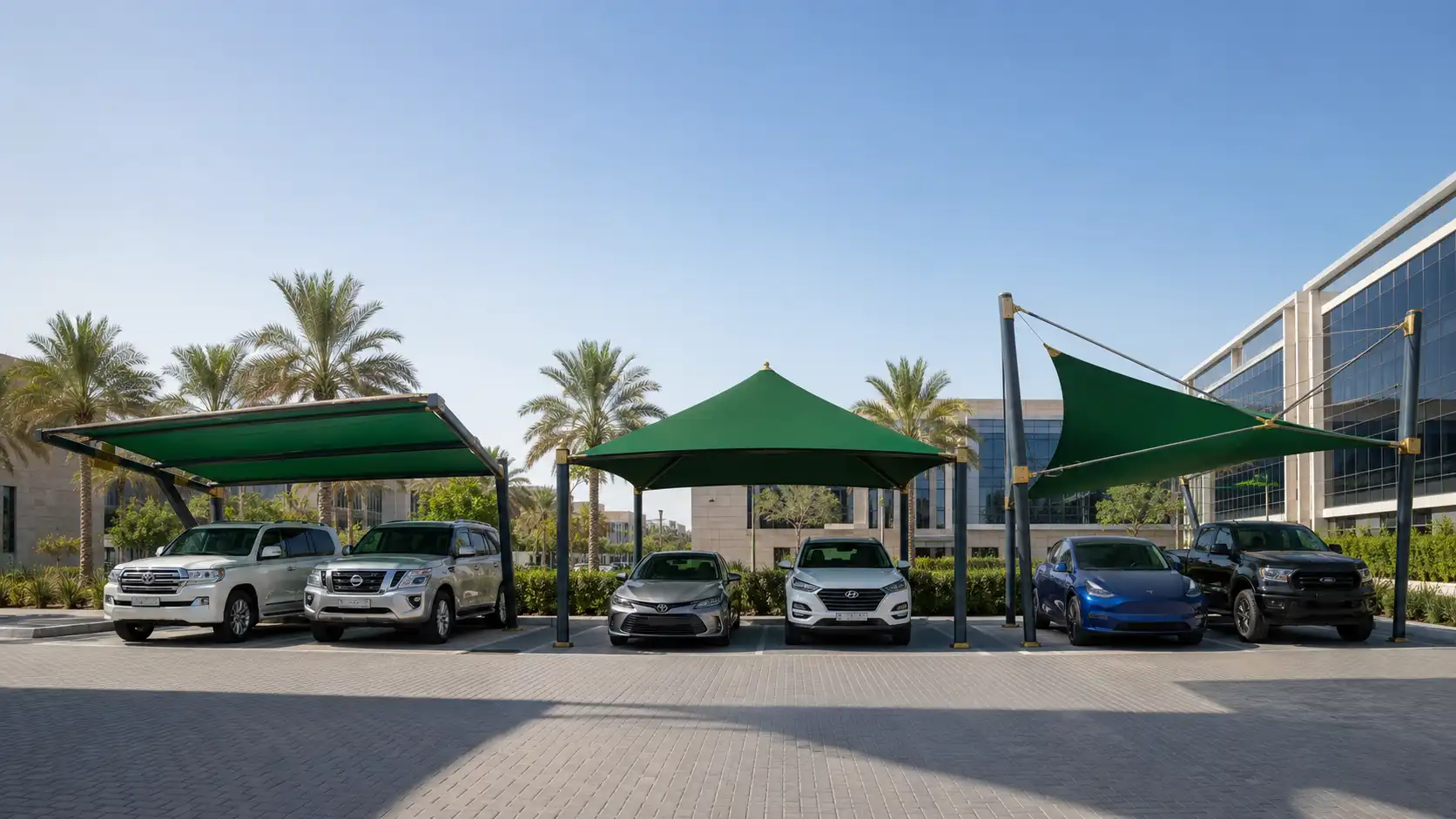
If you are comparing the main types of car parking shades, the short answer is this. A cantilever shade is best when you need clear, pole free parking bays. A pyramid shade is best when wind and rain performance matter most, or when you are covering a large open lot. A sail shade is best when appearance and flexible layout matter more than maximum weather protection.
Those three designs cover most parking structures installed across the UAE, and each solves a different problem. Choosing the wrong one usually shows up two or three years later as sagging fabric, pooled water, or a pole sitting exactly where a car door needs to open. This guide compares all three on span, cost, wind performance and real use cases, so you can match the structure to your property before requesting quotes for car parking shades in Dubai.
The Three Main Types of Car Parking Shades at a Glance
| Feature | Cantilever | Pyramid | Sail |
| Support method | One side only | Central or corner posts | Two or more anchor points |
| Typical span | 5 to 6 m per arm | 6 to 12 m | 4 to 8 m |
| Wind performance | Moderate | Strongest | Lowest |
| Rain drainage | Good | Best | Pooling risk if pitched poorly |
| Relative cost per sqm | Mid | Highest | Lowest |
| Best suited to | Tight bays and driveways | Large open lots | Villas and irregular plots |
| Visual style | Clean and modern | Formal and symmetrical | Decorative and architectural |
Read the table from the constraint you cannot change. A narrow plot makes the span and support method the deciding factors. An exposed site makes wind performance the deciding factor. Cost is usually the last filter, not the first, because the price gap between these designs is smaller than the cost of replacing a structure that never suited the site.
Cantilever Car Parking Shades
How it works
A cantilever shade is supported from one side only. A row of steel columns sits along a single edge, and an arm extends outward to carry the fabric or panel roof across the parking bay. Nothing touches the ground on the open side.
Strengths
The open side is the whole point. Drivers get an unobstructed bay, which makes reversing, opening doors and loading a boot far easier, and it lets you run two rows back to back off a single line of columns. Airflow underneath is excellent, so heat clears faster than it does under a tight, low structure. The profile is also the most modern looking of the three, which is why it appears on so many new villas, showrooms and apartment podiums.
Limitations
All the load transfers through one line of columns, so foundations must be deeper and heavier than a comparable pyramid frame, which raises the civil cost even when the steel cost looks similar. Span is limited too. Past roughly six metres of arm, section sizes and footing depth climb quickly. Wind performance is solid when the structure is properly engineered, but it is not the automatic first choice on a fully exposed site.
Best for
Villa driveways, townhouse and compound parking rows, car showrooms, and any bay where a pole would block a door or walkway.
Pyramid Car Parking Shades
How it works
A pyramid shade uses a four sided sloped roof carried on a central post or a set of corner posts. The fabric rises to an apex, which creates tension in every direction at once.
Strengths
That symmetry is a structural advantage, not just a visual one. Stress spreads evenly across the membrane instead of concentrating along one edge, so the fabric holds its tension longer and sags less over the years. The steep pitch sheds rain and dust fast, and the shape handles strong wind better than any other common design. Pyramid units also cover the largest area per structure and tile cleanly across a big lot, so cost per covered square metre falls as the project scales.
Limitations
The posts land inside or beside the parking area, which costs you layout flexibility and can complicate circulation on a tight plot. Individual structures cost more than a comparable sail, and installation takes longer because the frame is heavier and the tensioning more precise. On narrow residential plots a pyramid often does not fit well at all.
Best for
Shopping centres, schools, hospitals, mosques, offices, workforce parking, and exposed desert or coastal sites where Shamal winds are a genuine design factor.
Sail Car Parking Shades
How it works
A sail shade is a tensioned fabric membrane stretched between anchor points, usually with three or four fixing corners, and often arranged as overlapping triangles to cover a larger area.
Strengths
Nothing else looks like it. Sail shades give a property an architectural, resort style appearance while still delivering real UV protection, and the overlapping layout covers awkward, angled or curved spaces that a rectangular frame cannot handle. Material cost is the lowest of the three, installation is quick, and when the fabric ages you replace the membrane alone rather than rebuilding the structure. A ready made option such as a beige sail shade net suits smaller residential spaces where a fabricated frame would be excessive.
Limitations
Sails are the most sensitive to sustained wind, because load concentrates at a small number of anchor points and any slack in the membrane turns into flutter. Drainage depends entirely on pitch. A sail set too flat will pool water after heavy rain and stretch permanently. The membrane needs re tensioning over its life, and every anchor point must land on a wall, column or footing capable of taking the pull. If you need a full waterproof cover, this is the weakest of the three.
Best for
Villa courtyards, boutique hotels, cafes, resorts, poolside parking and any plot where the shape rules out a conventional frame. The same logic applies to the villa and garden shade solutions that sit alongside parking areas on many residential properties.
Other Types of Car Parking Shades Worth Knowing
Arch shades use a curved roof that sheds wind smoothly and blends with rounded architecture, sitting between cantilever and pyramid on cost and performance. Tensile membrane structures use engineered PVC or PTFE fabric in sculptural forms and suit landmark commercial projects with a real design budget. Umbrella shades cover single bays or small clusters and work well as infill. Polycarbonate roofs give fully waterproof cover with light transmission, at a higher cost and with more heat retention than breathable fabric. The same thinking applies to patio and terrace shades on the same property.
Car Parking Shade Materials: HDPE, PVC and PTFE
The design decides the shape. The material decides how long it lasts.
HDPE knitted shade net is the workhorse for UAE parking. It is breathable, blocks most UV, keeps the space underneath cooler because hot air escapes rather than being trapped, and typically lasts eight to twelve years with good UV stabiliser content. PVC coated fabric costs more but is fully waterproof and generally lasts ten to fifteen years. PTFE and PVDF membranes sit at the top of the range, with self cleaning surfaces and the longest service life, and are normally specified on premium developments.
GSM tells you the fabric weight. For residential parking, 280 to 320 GSM is the practical range, and a 280 GSM shade net roll covers most villa and compound applications. On very exposed lots, a more open weave around 70 percent shade factor is often smarter, because it lets wind pass through instead of fighting it.
The frame matters just as much. Hot dip galvanised and powder coated steel is the standard, and on coastal sites in Dubai, Sharjah and Ras Al Khaimah the salt air makes coating quality the biggest factor in how the structure looks after five years. Non standard sizes are best handled through a custom shade net stitching service rather than by forcing a stock panel to fit.
Car Parking Shade Price in the UAE
Prices move with material, span, height, foundation work and site access, so treat these as indicative ranges rather than quotations.
A single car residential structure of roughly 3 m by 6 m in HDPE typically starts from around AED 2,200 installed, and a two car shade from around AED 3,800, with per vehicle cost falling as you add bays. On commercial work, HDPE starts from around AED 180 per square metre, tensile membrane from AED 350 to AED 550, and polycarbonate from AED 320 to AED 480.
Location shifts the number too. Sharjah often sits five to ten percent below Dubai, while Ajman, Ras Al Khaimah and Fujairah run five to fifteen percent higher once transport is included.
How to Choose the Right Type for Your Property
Choose a cantilever shade if you have a villa driveway or a parking row and you cannot afford to lose bay width to a pole.
Choose a pyramid shade if you are covering a large open lot, or if your site is exposed to strong wind and heavy seasonal rain.
Choose a sail shade if appearance is a priority, the space is irregular, and the site is reasonably sheltered.
Choose polycarbonate or PVC if you need genuinely waterproof cover rather than shade alone.
Choose a tensile membrane structure if the parking area is part of the building’s architectural statement and the budget reflects that.
Frequently Asked Questions
Which is better, cantilever or pyramid car parking shade?
Neither is universally better. Cantilever wins when you need clear, pole free bays on a tight plot. Pyramid wins when the site is exposed to wind, when rain drainage matters, or when you are covering a large open lot.
How much does a car parking shade cost in the UAE?
A single car HDPE shade typically starts from around AED 2,200 installed, and a two car structure from around AED 3,800. Commercial HDPE work starts from around AED 180 per square metre, and tensile membrane systems from around AED 350 per square metre.
How long do car parking shades last?
HDPE fabric generally lasts eight to twelve years in UAE conditions. PVC coated fabric lasts ten to fifteen years, and PTFE or PVDF membranes longer still. A galvanised and powder coated steel frame normally outlives several fabric replacements when properly maintained.
Which type of car parking shade is best for high wind areas?
Pyramid shades perform best in high wind, because the four sided slope distributes load evenly and lets wind pass over the surface. Pairing that shape with a more open weave around 70 percent shade factor reduces frame load further.
Is HDPE or PVC better for car parking shades in Dubai?
HDPE is better for heat and UV control because it breathes and lets trapped hot air escape, and it costs less. PVC is better when you need waterproof cover and longer fabric life. Most residential parking in Dubai is served well by HDPE.
What is the best car parking shade for a villa driveway?
A cantilever shade usually suits a villa driveway best, because it keeps the bay completely clear and works on narrow plots. If the driveway is irregular or appearance is the priority, a sail shade is the stronger alternative.
Getting the Specification Right
Among the types of car parking shades available in the UAE, the design you choose shapes how the parking area works every day, and the material decides how it looks in year eight. Match the structure to your plot, wind exposure and drainage needs first, then set the material grade against your budget. For a recommendation based on your actual site dimensions, request a free car parking shade quote before you commit.