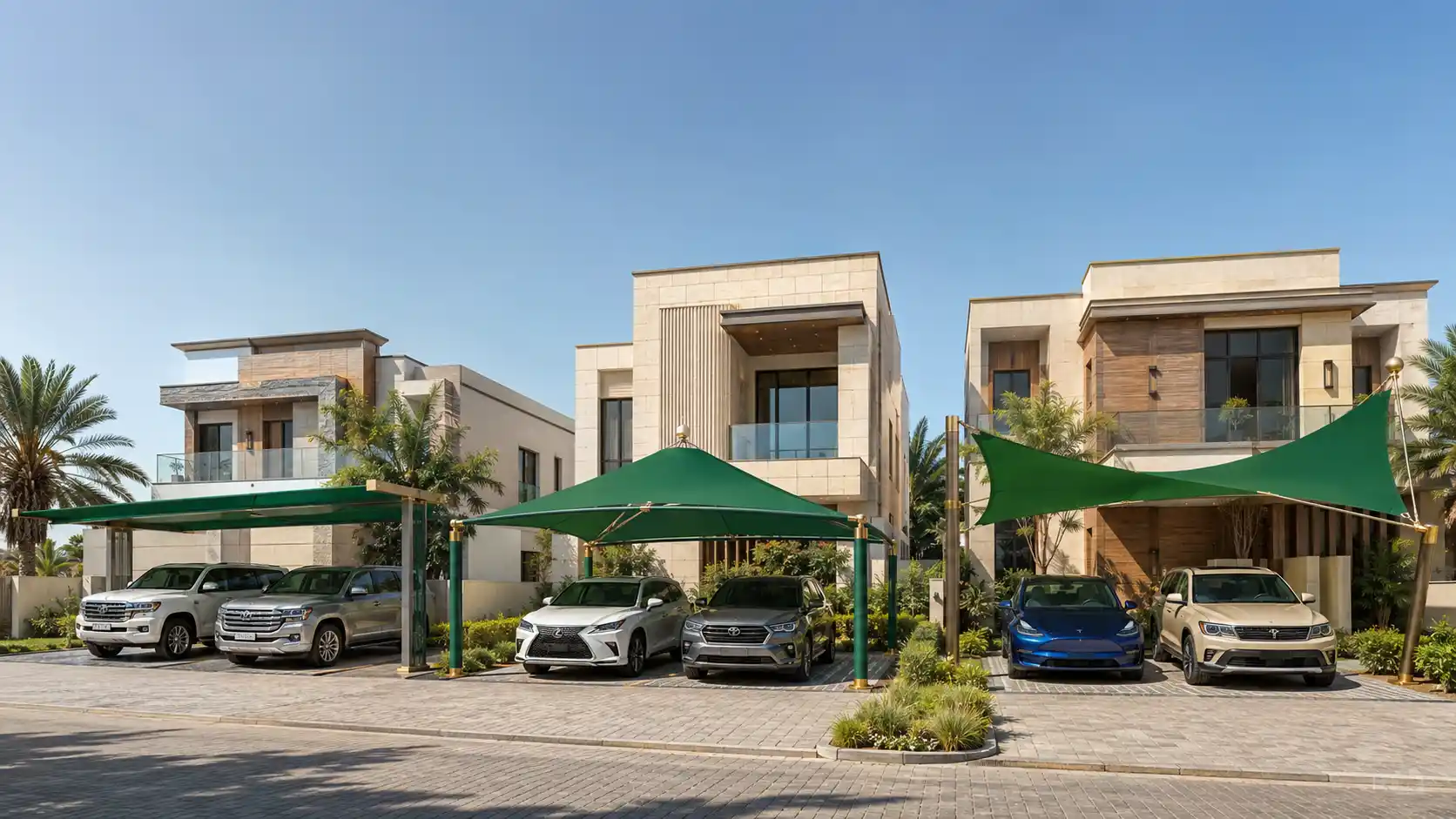
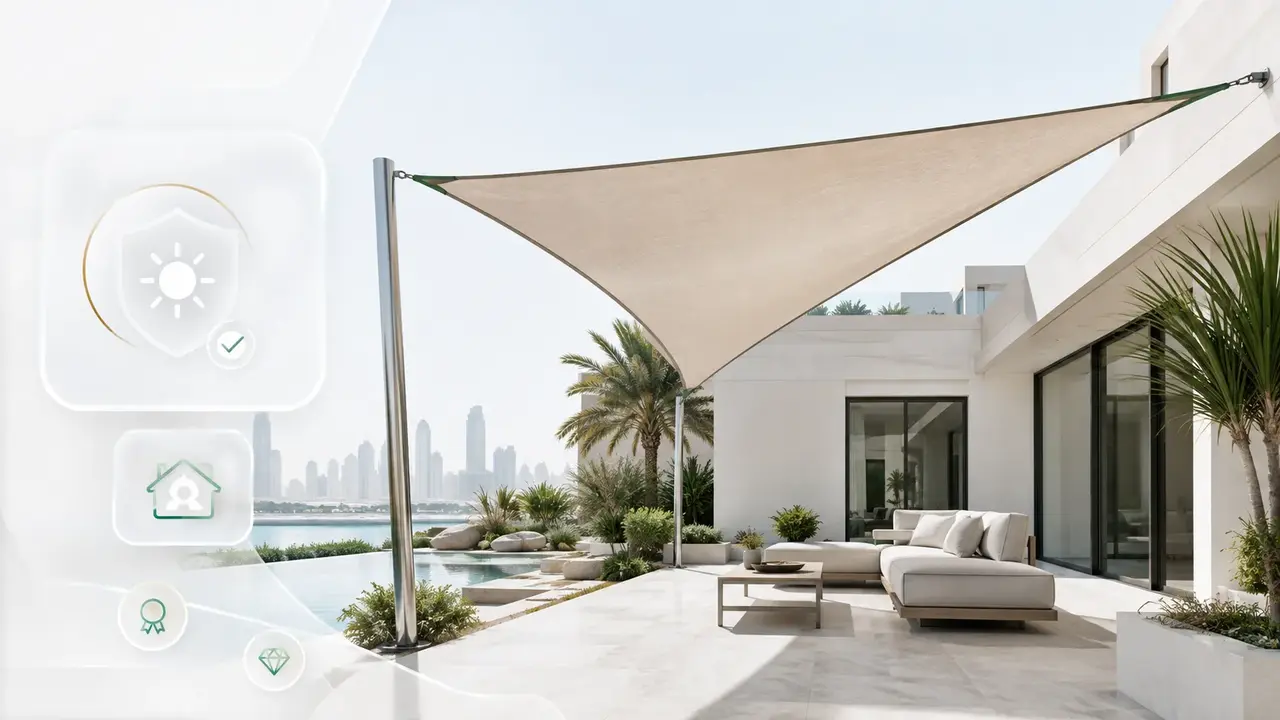
Dubai and Abu Dhabi summers push outdoor spaces past comfortable for months at a time, and a well-chosen shade sail can turn a scorching villa garden into a space you actually use. A shade sail is a tensioned fabric canopy stretched between fixed points, and it is one of several ways our villa garden shade team helps UAE homeowners cool down a pool deck, courtyard, or seating area without the cost of a solid roof. The right sail depends on fabric type, GSM, shape, and how it gets mounted, all of which matter more here than in a milder climate. This guide walks through fabric options, GSM and UV block, shape and sizing, and what installation looks like in a villa compound, so you can choose with confidence rather than guesswork.
Key takeaways:
- HDPE knitted fabric suits most villa gardens and pool decks. PVC-coated fabric is the choice if you need real rain protection.
- Look for a mid-to-high GSM for UAE sun exposure, not the lightest fabric on the shelf.
- Triangular and square shapes work well for pools and courtyards. Overlapping sails cover larger or irregular areas.
- Mounting points need to handle shamal-season winds, so professional installation matters more here than in a milder climate.
- Check your community’s guidelines before fixing posts to a shared wall or boundary fence.
What Is a Shade Sail and Where UAE Villas Use Them
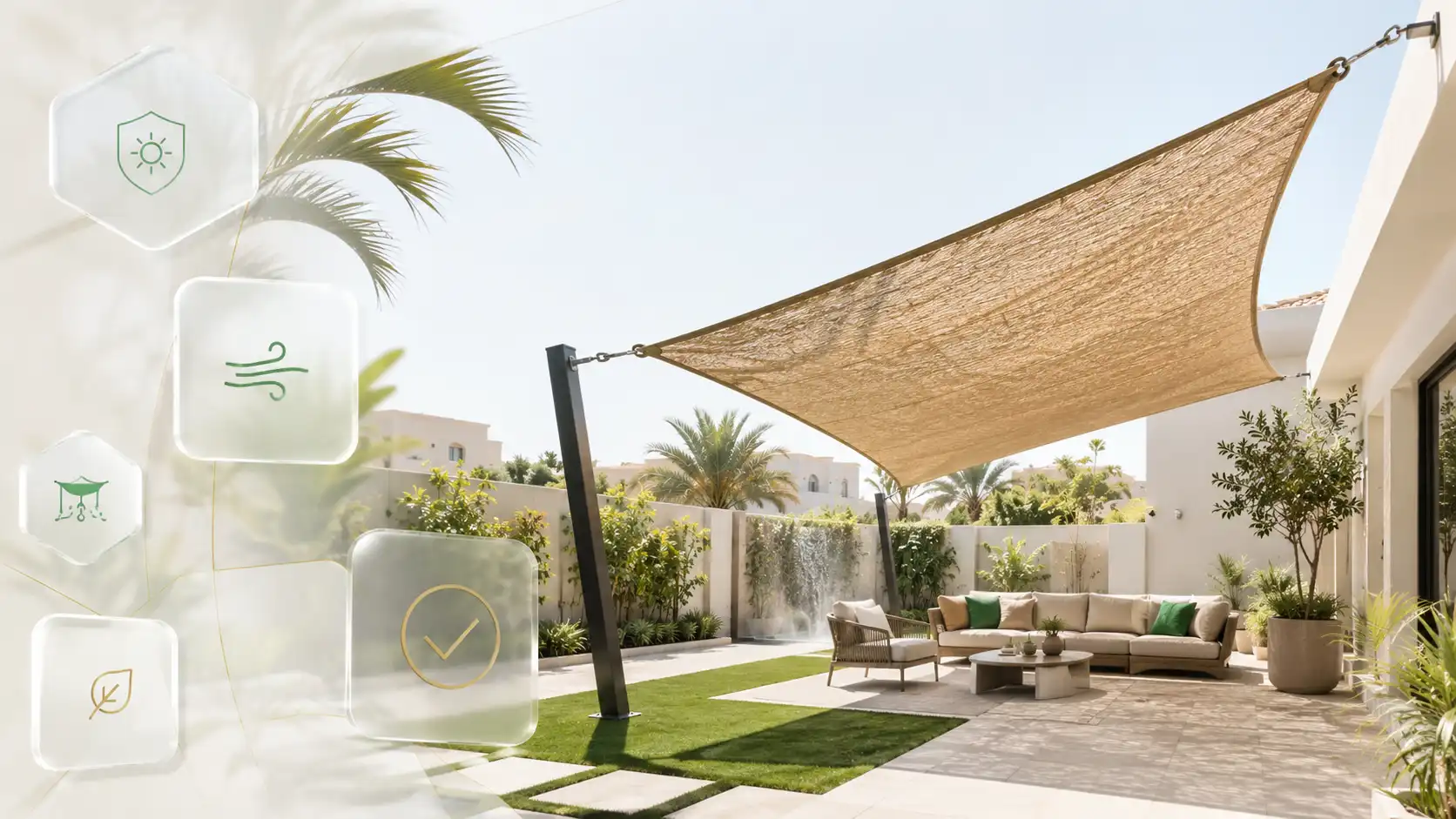
A shade sail is a piece of tensioned fabric, usually triangular, square, or rectangular, stretched between three or more fixed points to create shade over an outdoor space. UAE villa owners use them over pool decks, courtyards, majlis seating, kids’ play areas, and parking bays, since one sail covers a large area for less than a fixed roof would cost. A single well-placed sail can shade an entire seating area or half a pool deck, which is why it remains one of the more cost-effective shade upgrades for a villa.
If you need shade for a smaller, more enclosed space like a covered terrace, our patio and terrace shade page covers options built specifically for that. Most villas end up using a mix of shade types, with sails handling the open garden or pool area and a different structure covering a tighter space closer to the house.
Shade Sail Fabric Types: HDPE Knitted vs PVC-Coated
Two fabric families cover almost every villa shade sail sold in the UAE, and choosing between them comes down to one question: do you need the sail to block rain, or just sun?
HDPE knitted fabric is the standard choice for most gardens and pool decks. It lets some air through, which keeps the area underneath cooler, and it handles UAE sun well once the GSM is high enough. It will not keep rain out, though light showers mostly pass through rather than pooling on the fabric.
PVC-coated fabric is a solid, non-breathable membrane. It blocks rain completely, which makes it the better choice for a covered majlis or outdoor dining area you want to use in any weather. It holds more heat than HDPE, since less air moves through it, and it tends to cost more.
| Fabric | Blocks rain | Airflow | Best for |
| HDPE knitted | No | High | Pool decks, open gardens, play areas |
| PVC-coated | Yes | Low | Covered majlis, dining areas, rain-sensitive spots |
Both fabric types come in a range of colors, and darker shades tend to block slightly more heat than lighter ones, though the difference is smaller than most buyers expect. For most villa gardens, HDPE is the practical choice. Our beige sail shade net is an HDPE option suited to everyday villa use.
Choosing the Right GSM and UV Block for UAE Sun
GSM stands for grams per square metre, and it is the simplest way to compare how dense a fabric is. A higher GSM generally means a tighter weave, a stronger UV block, and a fabric that holds its shape better under UAE sun and wind.
For a villa in the UAE, it is worth choosing a mid-to-high GSM fabric rather than the lightest option available, since the sail will spend most of the year under intense direct sunlight. A denser fabric also resists the wear that comes from sand and dust carried on the wind, which is a bigger factor here than in most other climates.
UV block matters just as much as GSM. Look for a fabric rated to block a high percentage of direct UV rather than just “sun protection” on the label, since that phrase alone does not tell you much. A sail with a lower UV block might look identical from a distance, but the difference shows up in how hot the space underneath feels by midafternoon, and in how quickly the fabric wears out under years of direct sun.
Shapes, Sizing, and Wind Considerations for Villa Installations
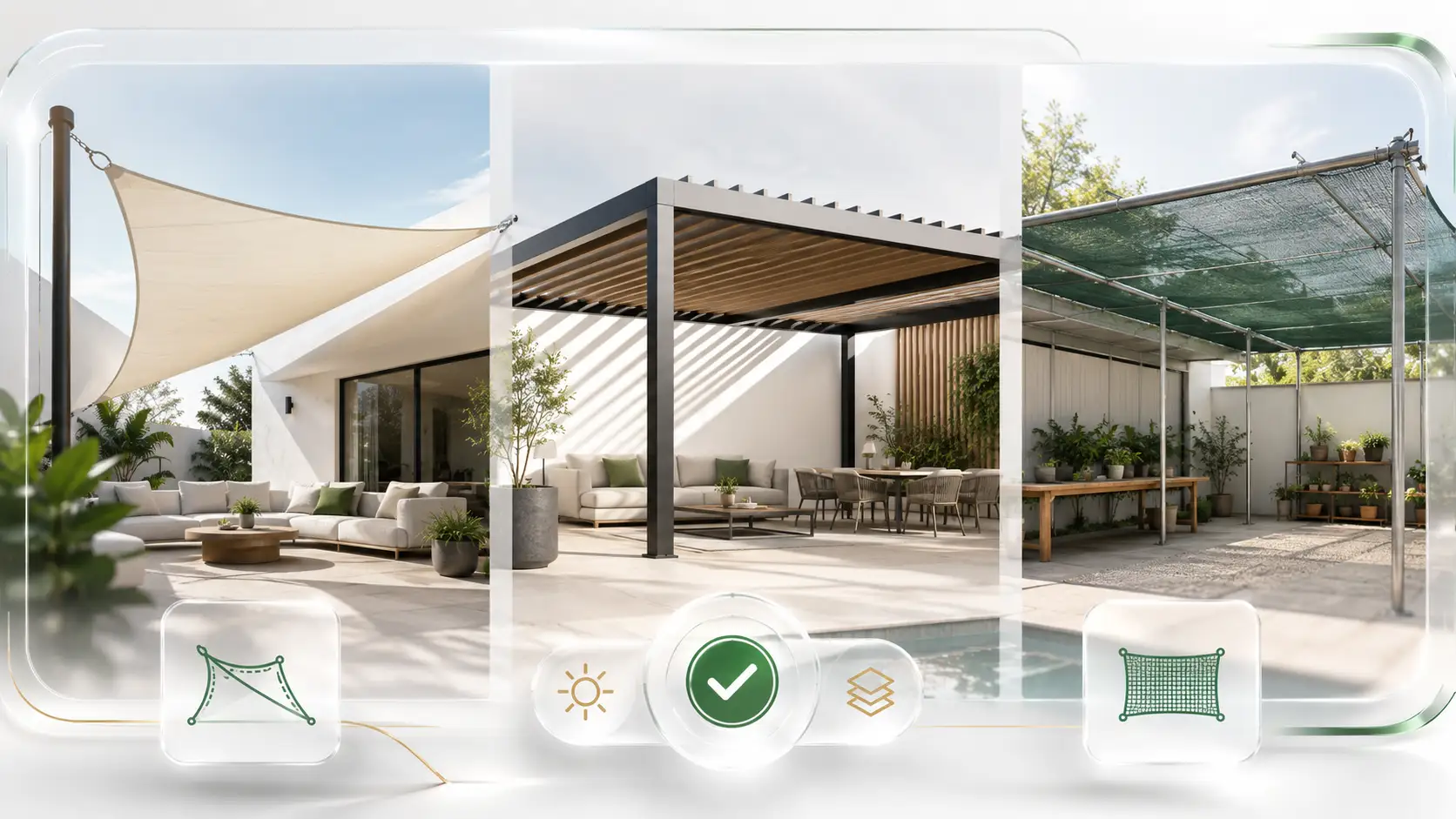
Shade sails come in triangular, square, rectangular, and overlapping configurations. Triangular sails suit pool corners and smaller courtyards, since three mounting points are easier to fit into a tight layout. Square and rectangular sails cover more area with fewer seams, which works well over a wider patio or seating zone. Overlapping sails, where two or three sails are layered at different heights, cover larger or oddly shaped gardens and add visual depth.
Sizing needs to account for droop and tension, not just the flat area you want covered. A sail cut exactly to the space will sag once it is tensioned, so most installers size the fabric slightly larger than the coverage area and pull it taut across strong anchor points. When measuring for a villa installation, plan for anchor points on existing walls, fence posts, or freestanding poles, and leave enough clearance so nobody can touch the fabric while standing on a chair or ladder. A site visit from an installer is the easiest way to confirm measurements and mounting options before ordering fabric.
Wind is the part UAE buyers most often underestimate. Shamal winds can put real load on a sail and its mounting points, so posts, wall brackets, and turnbuckles all need to be rated for more than a calm-weather install. A sail that looks fine on a still day can fail during a wind event if the anchor points were never built to handle it.
Installation, Community Approval, and Maintenance
A shade sail looks simple once it is up, but getting the tension and anchor points right takes some experience. DIY installation is possible for a small, simple sail using existing wall fixings, but anything involving new posts, a pool area, or a larger span is worth handing to a professional installer who can calculate the load properly.
Before fixing posts to a shared wall, boundary fence, or anywhere visible from the street, check your community’s guidelines. Some UAE villa communities have rules about structures attached to shared walls or visible from outside the property, and it is far easier to check first than to remove a sail later.
Maintenance is light compared to a solid roof. Check the tension every few months, especially after a strong wind event, and re-tighten turnbuckles if the fabric has started to sag. Clean the fabric occasionally to clear dust, since a buildup of sand can shorten the life of the weave over time.
If you are ready to move forward, send a few photos of your space on WhatsApp at +971 50 574 1557 and our team can talk through fabric, GSM, and sizing for your specific villa layout.
Frequently Asked Questions
What GSM is best for a shade sail in the UAE?
A mid-to-high GSM fabric works best for most UAE villas, since it holds up better under constant sun and wind-blown dust than a lighter fabric. The exact number depends on the sail’s size and how exposed the location is, so it is worth checking the spec sheet rather than judging by price alone.
Do shade sails block rain?
It depends on the fabric. Standard HDPE knitted sails let some rain pass through rather than blocking it fully. PVC-coated fabric is a solid membrane that blocks rain completely, so it suits a covered majlis or dining area better than a garden or pool sail.
How long does a shade sail last in UAE conditions?
Lifespan depends heavily on fabric quality, GSM, UV exposure, and how well the sail is maintained. Regular tension checks and occasional cleaning extend the life of any sail. Rather than a fixed number of years, think of it as an investment that pays off longer the better it is specified and cared for.
Which fabric is better for a villa shade sail, HDPE or PVC?
HDPE knitted fabric suits most villa gardens and pool areas, since it breathes and keeps the space underneath cooler. PVC-coated fabric is the better pick if you specifically need rain protection, such as over a covered majlis or outdoor dining space.
Do I need community or HOA approval to install a shade sail at my villa?
Many UAE villa communities have guidelines about structures attached to shared walls, fences, or anything visible from outside the property. Check your community’s rules before installing posts or brackets, since requirements vary between developments.
Can I install a shade sail myself, or do I need a professional?
A small sail using existing wall fixings can sometimes be a DIY job. Anything involving new posts, a pool area, or a larger span is worth having a professional install, since the anchor points need to handle real wind load.
How much wind can a UAE shade sail withstand?
That depends on the fabric, size, and especially the strength of the mounting points and posts, not just the sail itself. Since shamal winds can put real strain on a poorly anchored sail, it is worth having a professional confirm your anchor points are rated for the conditions rather than assuming a standard install will hold.
Final Thoughts
A shade sail is one of the most practical ways to make a UAE villa’s outdoor space usable through the hottest months, as long as the fabric, GSM, and mounting are matched to local sun and wind. It is not the right fit for every space, though. If you want full weather protection or a fixed roofline, a pergola or a covered structure may suit better, and our team can talk through both options honestly rather than push a sail where it is not the best fit.
To get started, send a photo of your villa’s outdoor space on WhatsApp to +971 50 574 1557 for a free, no-obligation recommendation on fabric and sizing.